


Case Study 2
Solving Everyday Roommate Conflicts Through Design
A simple tool that helps students with roommates manage chores, expenses,
and shared living without conflict.
💼
Self Project
🕓
3 weeks
Role : Product Designer
February 2026
CHALLENGE
Roommates struggle to manage chores and shared expenses because communication is inconsistent
and responsibilities feel unfair.
GOAL
Reduce misunderstandings and help roommates maintain a fair and comfortable living environment.

Understand The User
Before the research, I assumed that shared expenses would be a major source of conflict. However, the interviews showed that most people manage expenses well using apps.
Instead, the bigger challenge comes from differences in lifestyle and daily habits.
Problems
Chores become unclear when responsibilities are not defined
Lifestyle differences create friction
Tracking shared expenses requires multiple tools
Communication needs requires effort.
Design Takeways
Based on the research insights, I focused on three principles : making responsibilities visible, keeping it simple, and support fairness without creating tension.

Age : 22
Education : Year 2 college student
Hometown : Tokyo
Family Status : Middle child
Persona 1
“As someone with changing schedules, I want a system that allows chores to be flexible so it fits into our daily life.”
Frustrations
・Chores can become unclear
・Fairness depends on schedules
・Hard to manage if non-family roommates
Goals
・Avoid conflict
・Keep the chores run smoothly
・Make sure roommates feel balance
“Whoever can do it does it, but it might be better to divide things clearly”
- Duo Mouri
Age : 24
Education : Year 4 college student
Hometown : Osaka
Family Status : Eldest child
Persona 2
“As a roommate, I want to track house routines and shared expenses in one place so that we both clearly understand who paid what and so.”

Frustrations
・Lifestyle differences
・Uneven effort when roles are not defined
・Adjusting to different habits
Goals
・Fair distribution of responsibilities
・Transparency with money
・Predictable routines
“At first we didn’t divide chores, but it started to feel uneven” - Mia Hirose
Starting The Design

Brainstorm
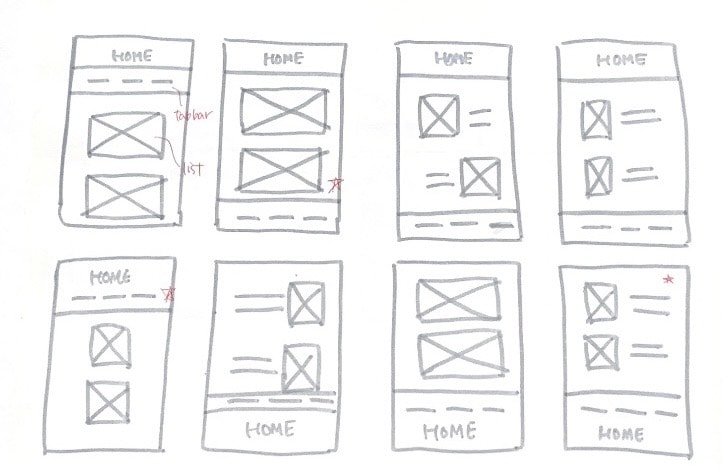
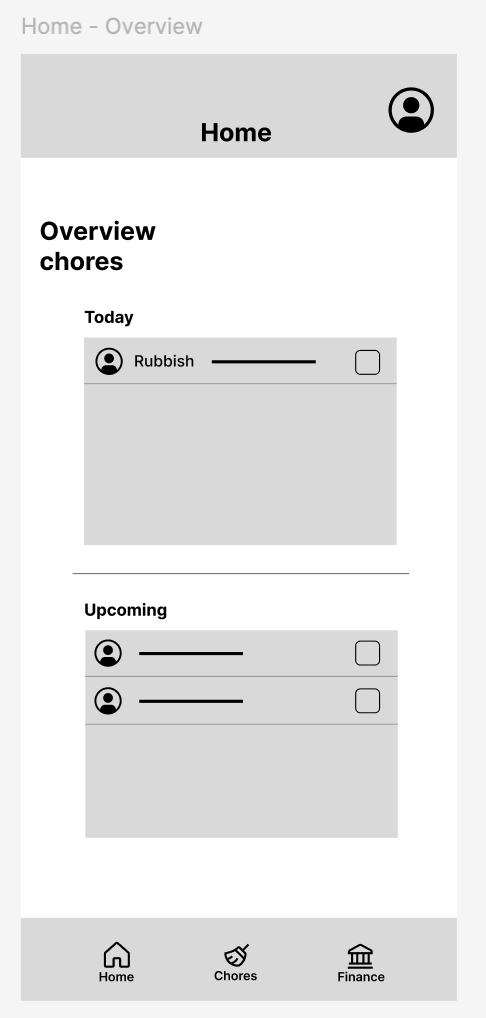
Centralized navigation minimizes tool-switching and keeps all household information accessible within one app.
Clear task assigned increases accountability and reduces household friction.


Goals
・Make daily responsibilities easy to scan
・Provide shared expenses with clarity
Thoughts Process
・“Today” and “Upcoming” improves prioritization
・Minimal layout reduces cognitive load
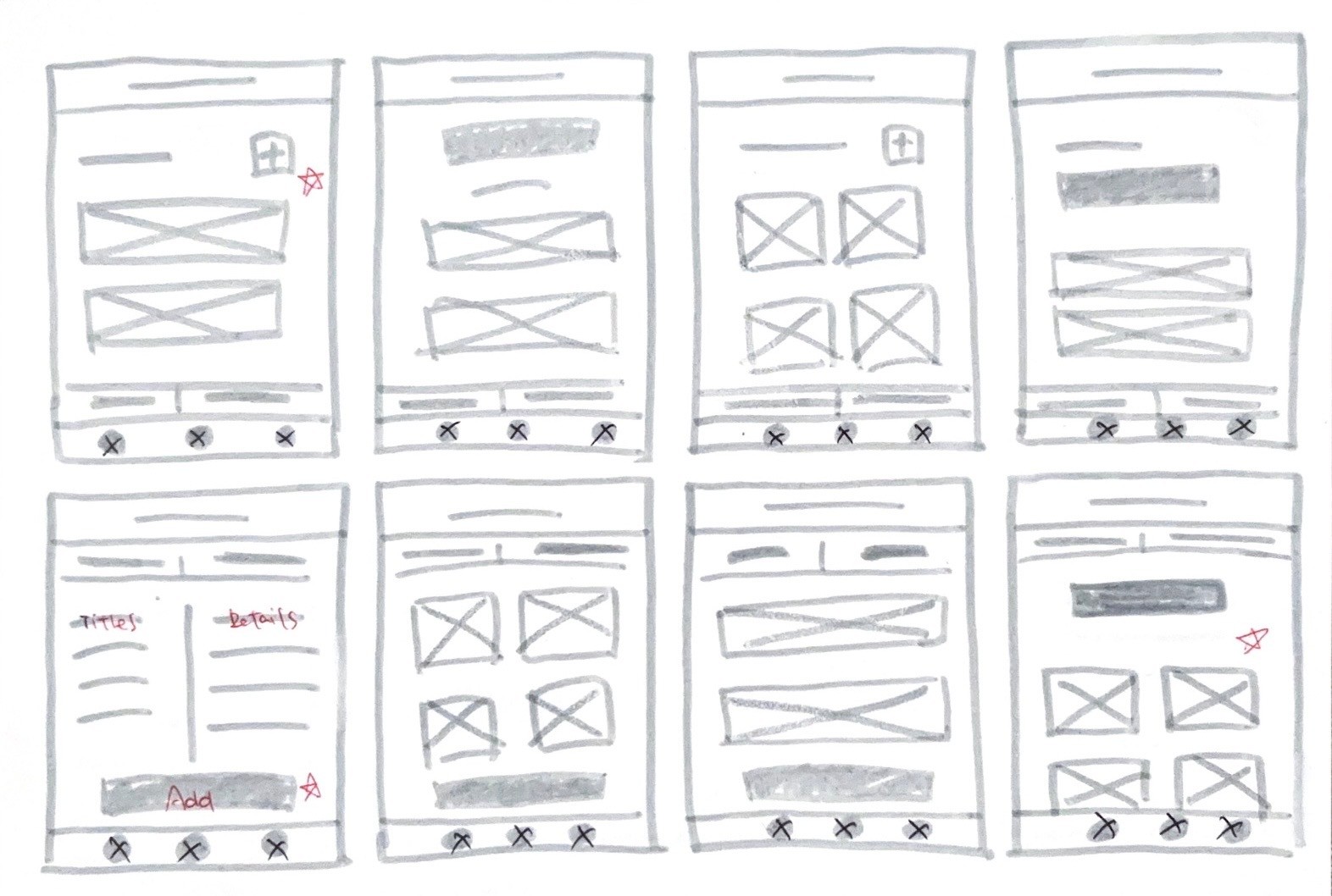
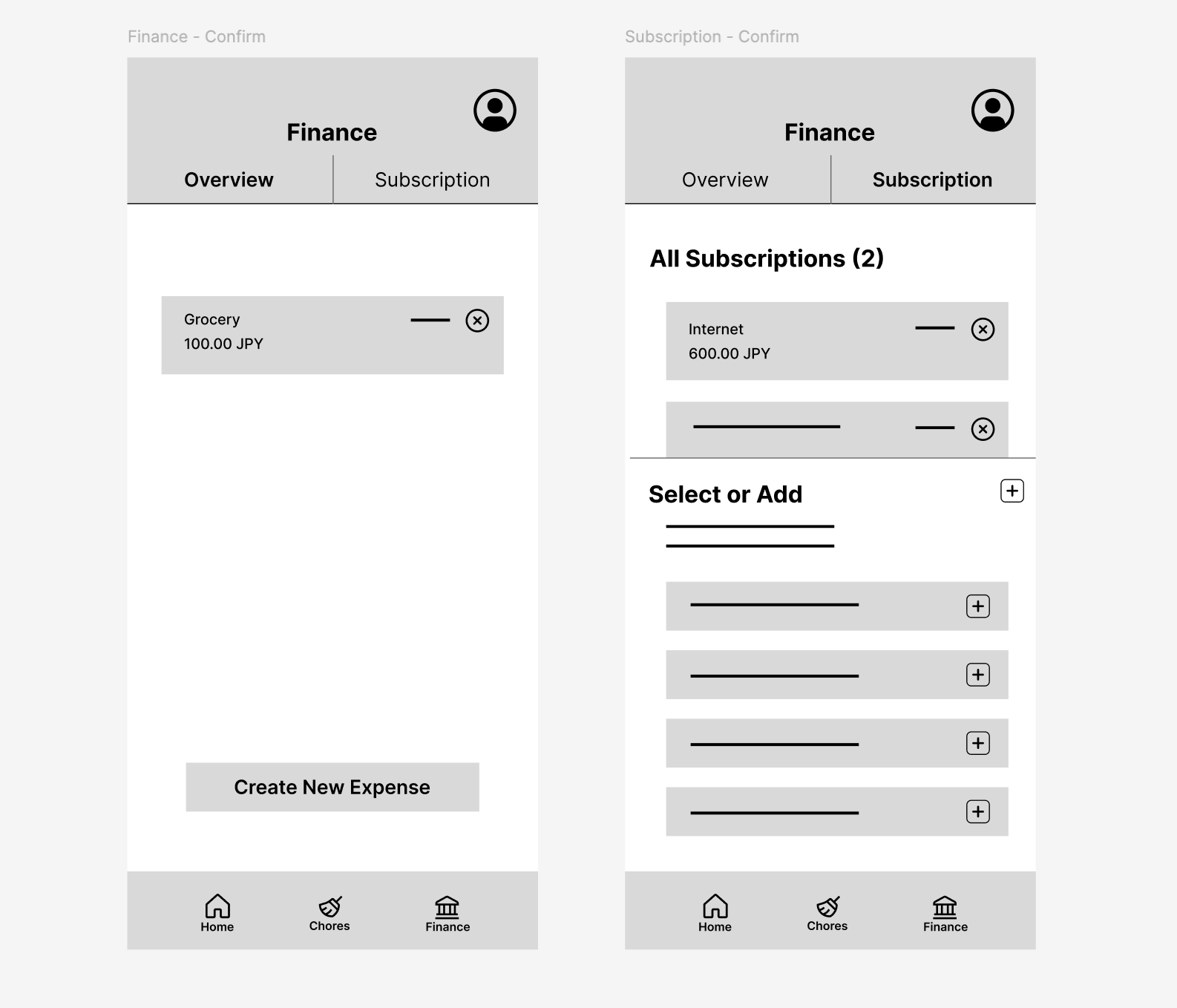

Separating one-time expenses from recurring subscriptions improves financial transparency.
Goals
・Provide roommates shared expenses with clarity
・Simplify adding and managing household costs
Thoughts Process
・Users need a quick overview of shared expenses
・“Overview” and “Subscription” improve routine
User Flow
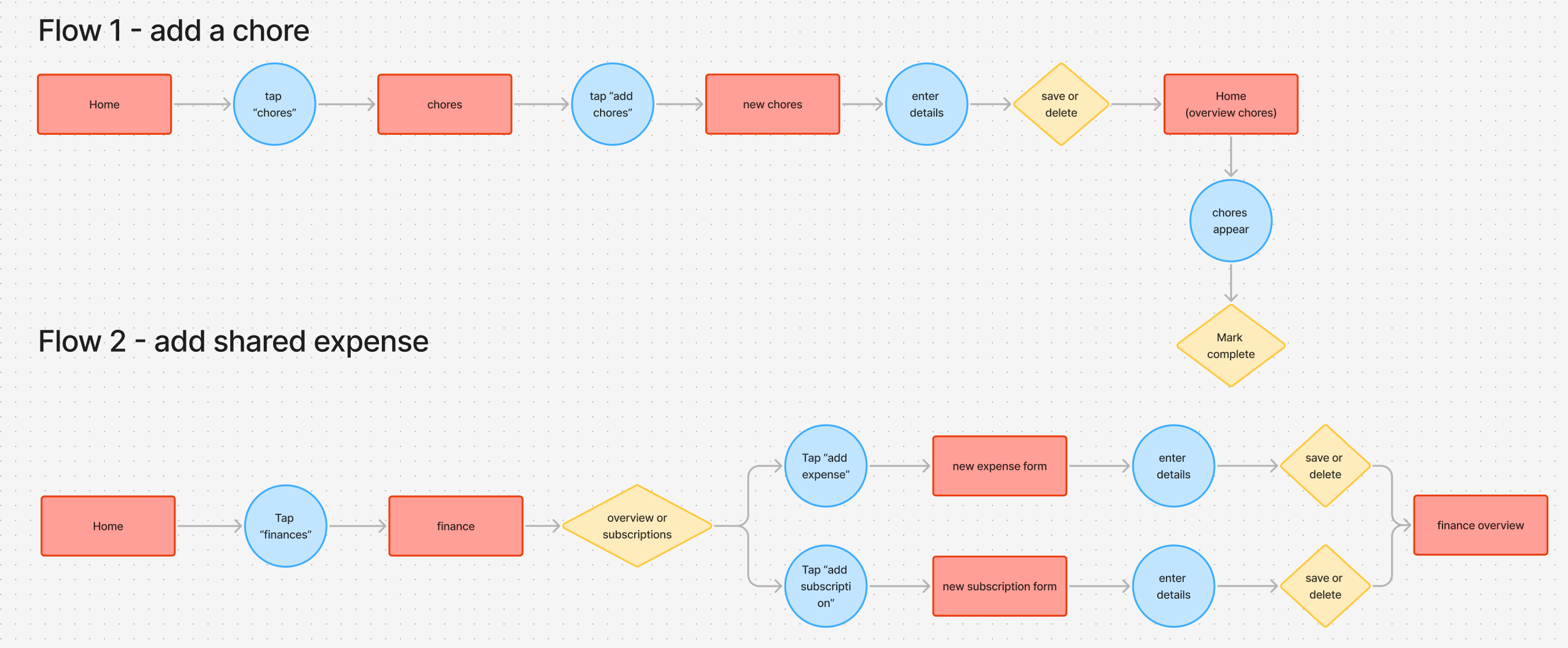
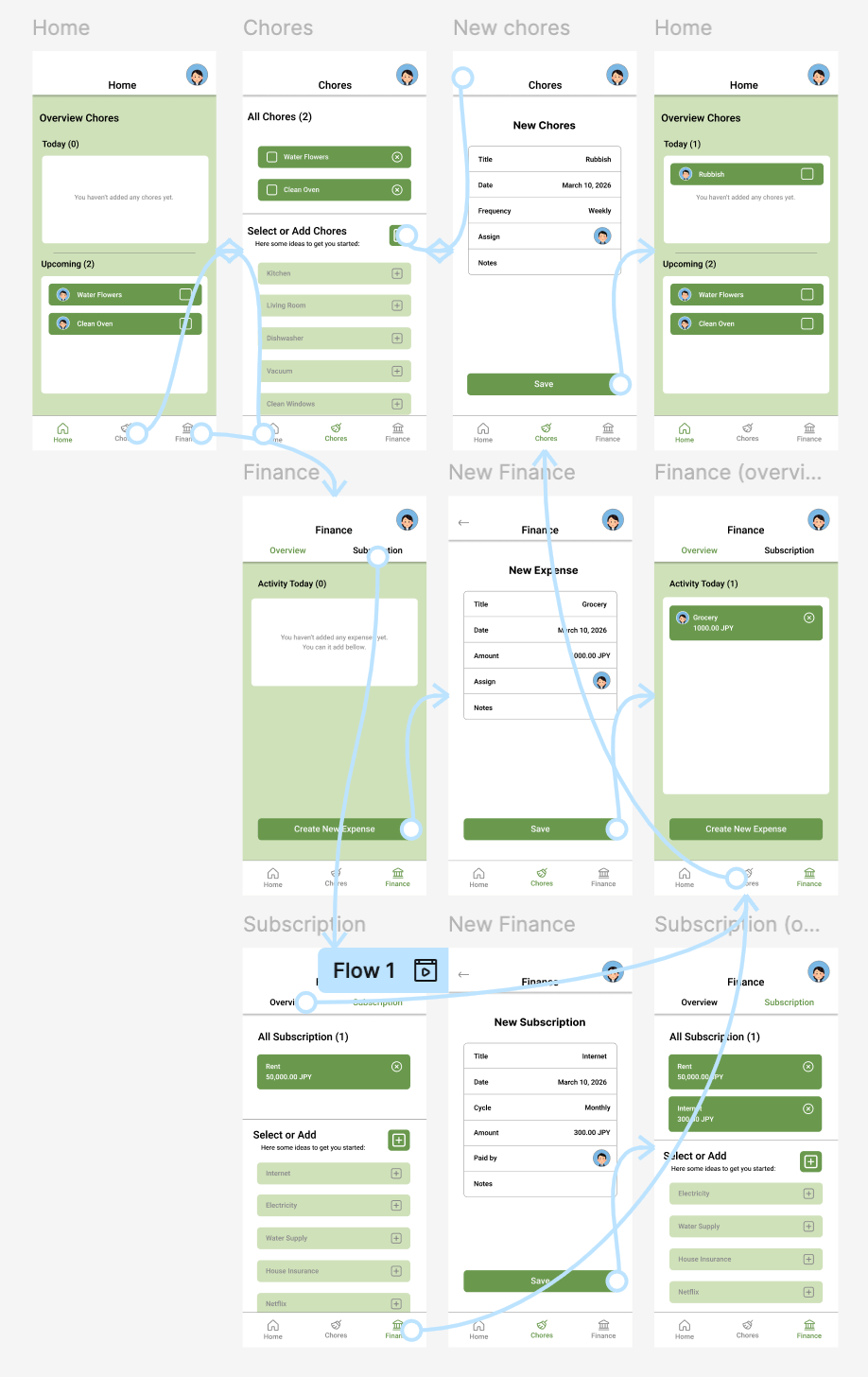
Outlines two primary tasks. The structure minimizes friction and ensures users can quickly return to an updated overview after completing action.
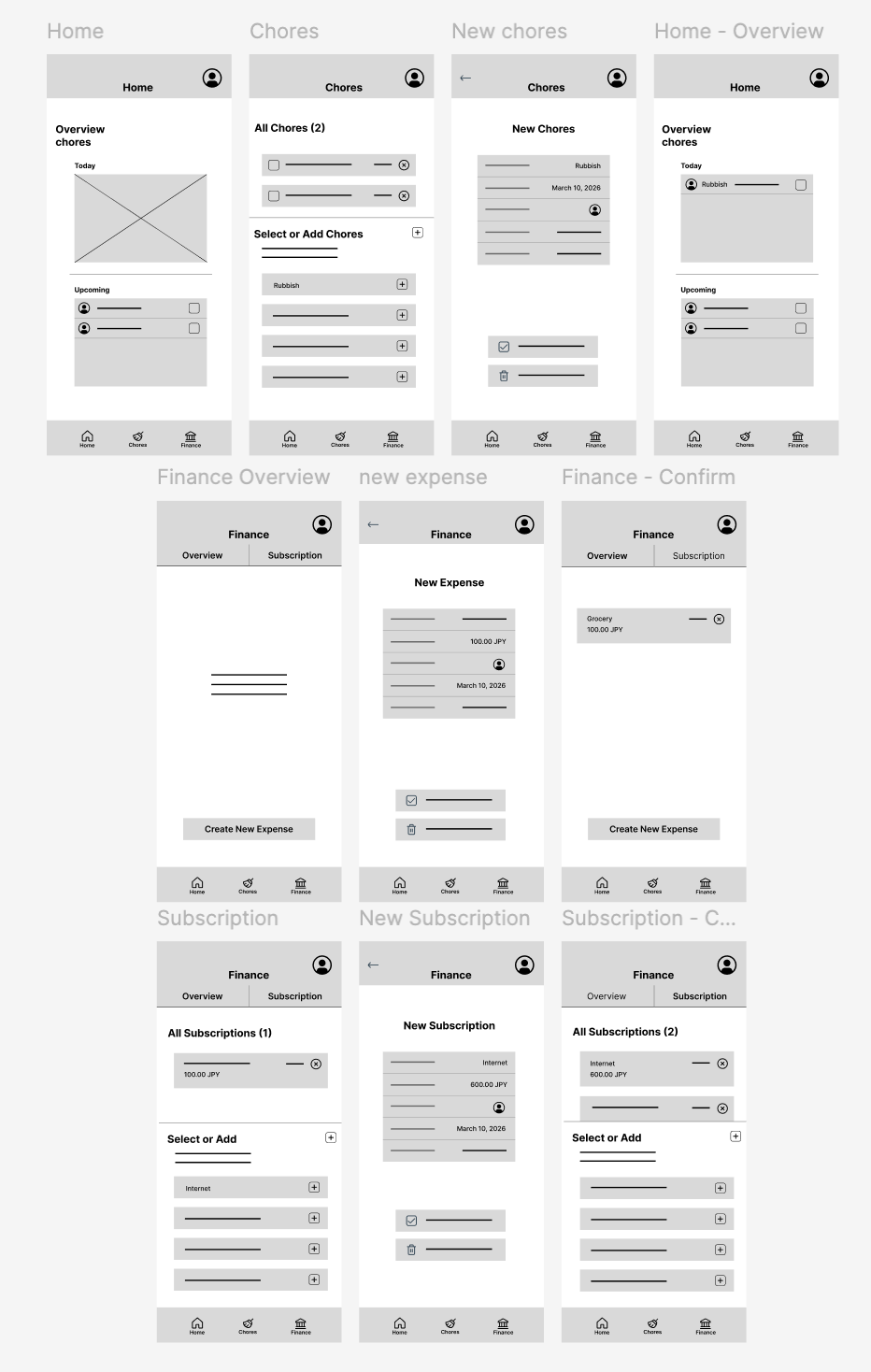
Lo-Fi Wireframe
Refining The Design
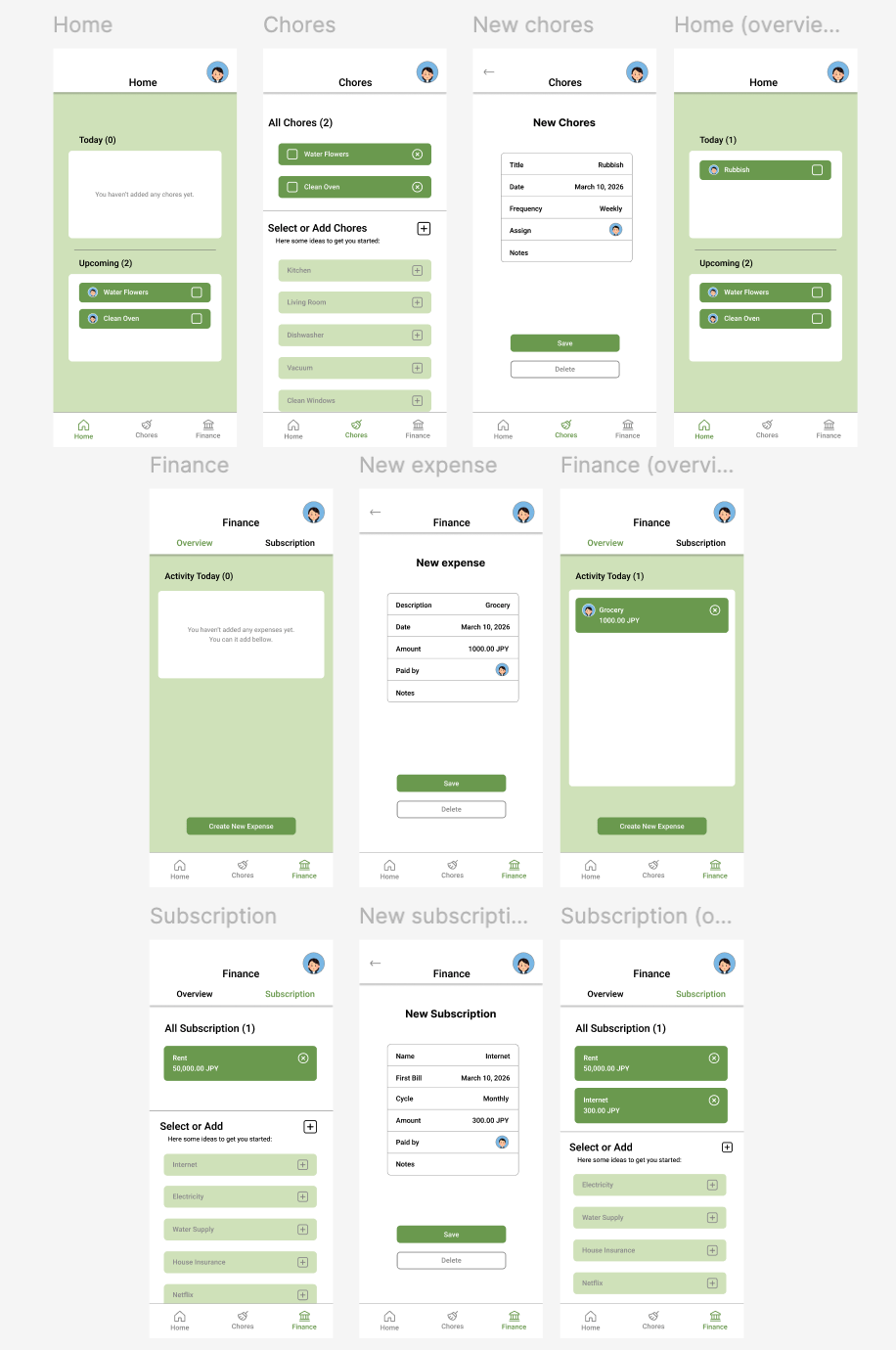
Mockups
Usability Study
I conducted a moderated usability study to evaluate how effectively users could manage and organize household chores within the app. The goal was to understand how users interpret the home screen structure, complete core tasks, and navigate key actions such as adding and assigning chores.
Findings
Users prefer time-based organization.
Participants expected tasks grouped by Today and Upcoming, not by member, to quickly see what needs immediate attention.
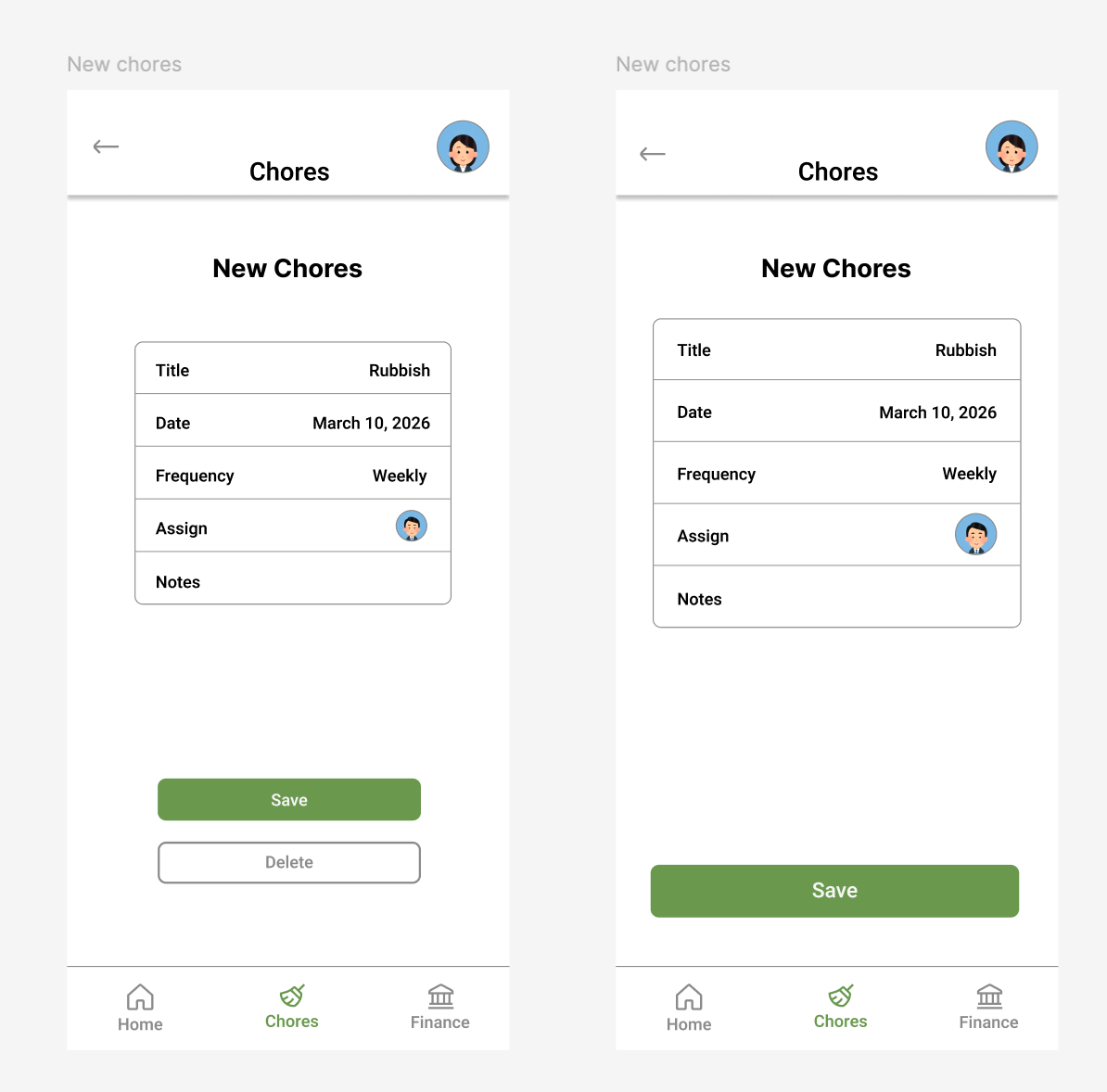
Back navigation and Delete action create confusion. Users were unsure whether tapping the back icon would cancel changes, creating hesitation and error risk.
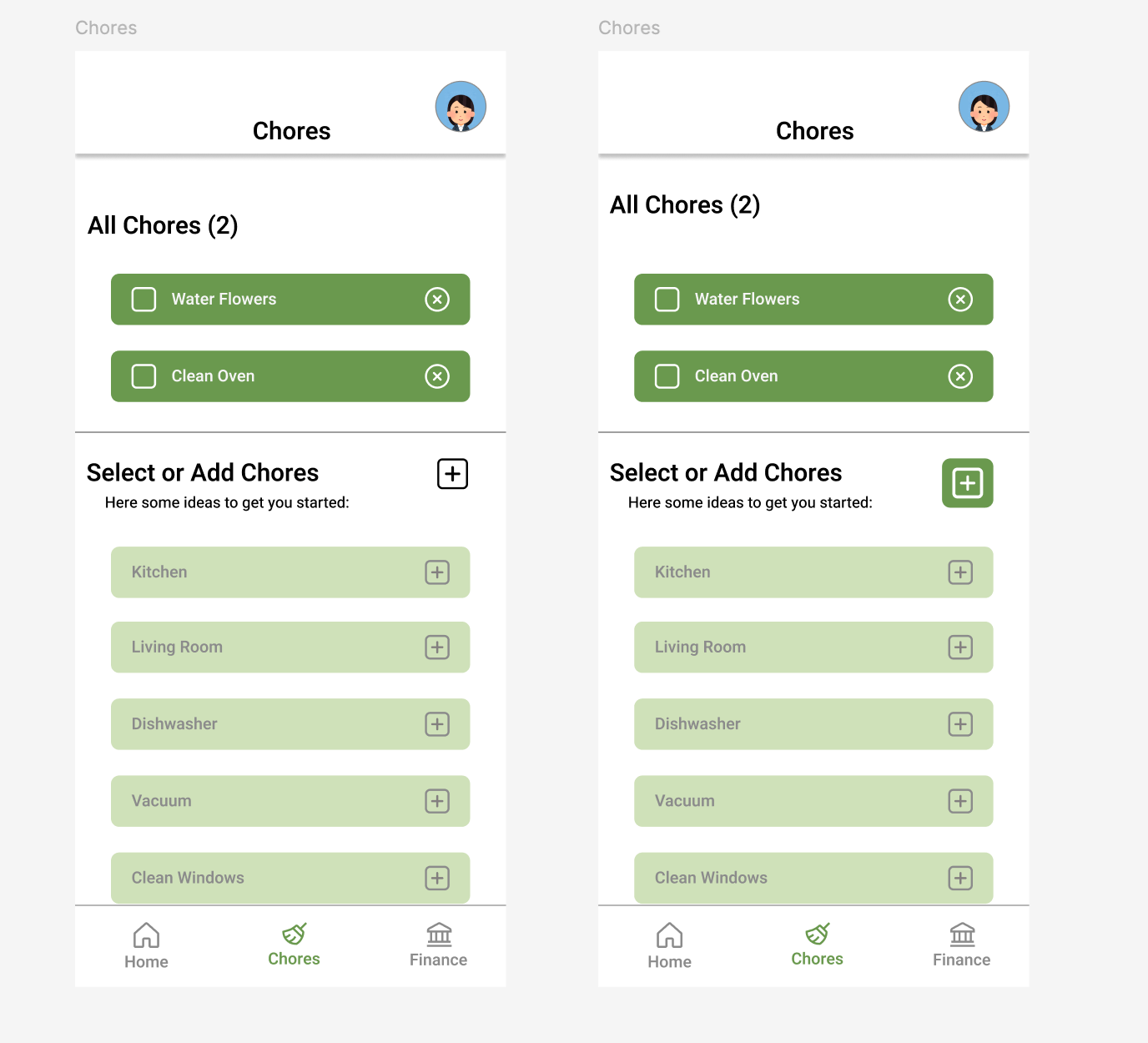
“Add Chores” lacks visibility. The primary action does not stand out, reducing discoverability and creating friction in the core flow.
Before
After
Goals
・Make “Add Chores” immediately noticeable
・Reduce task friction
Thoughts Process
・Increased contrast and visual weight of the CTA
・Clarified primary vs. secondary actions
Before
After
Goals
・Eliminate ambiguity between Back and Delete
・Prevent accidental data loss
Thoughts Process
・Elevated Save as the clear primary action
・Reduced visual competition for navigation and CTA
Hi-fi Prototype
Project Takeaways
Learnings
The quality of insights depends on how questions are framed. Subtle changes in wording can shape participant responses. Improving my ability to ask neutral, open-ended questions is essential to conducting more reliable and unbiased usability research.
Behavior reveals unspoken friction. Hesitation, repeated taps, and scanning patterns exposed confusion users did not verbalize. Observing interaction patterns was critical in identifying hidden usability gaps.
Next Steps
Support roommate communication.
Although the app enhances task clarity, resolving conflicts still requires external communication, so adding lightweight in-app messaging or shared resources could improve collaboration.
Refine interaction details and expand functionality.
Enhance details such as a calendar date picker, clearer assignment visibility, and stronger interaction states.
© 2026 Harunainbloom
Projects
Case Study 1
+81 90 1912 0506
Case Study 2
seancespring@gmail.com
More questions ?
Case Study 2
Solving Everyday Roommate Conflicts Through Design
A simple tool that helps students with roommates manage chores, expenses, and shared living without conflict.
💼
Self Project
🕓
3 weeks
Role : Product Designer
February 2026
CHALLENGE
Roommates struggle to manage chores and shared expenses because communication is inconsistent
and responsibilities feel unfair.
GOAL
Reduce misunderstandings and help roommates maintain a fair and comfortable living environment.
Understand The User
Before the research, I assumed that shared expenses would be a major source of conflict.
However, the interviews showed that most people manage expenses well using apps.
Instead, the bigger challenge comes from differences in lifestyle and daily habits.
Problems
Chores become unclear when responsibilities are not defined
Lifestyle differences create friction
Tracking shared expenses requires multiple tools
Communication needs requires effort.
Design Takeways
Based on the research insights, I focused on three principles : making responsibilities visible, keeping it simple,
and support fairness without creating tension.
Age : 22
Education : Year 2 college student
Hometown : Tokyo
Family Status : Middle child
Persona 1
“As someone with changing schedules, I want a system that allows chores to be flexible so it fits into our daily life.”
Frustrations
・Chores can become unclear
・Fairness depends on schedules
・Hard to manage if non-family roommates
Goals
・Avoid conflict
・Keep the chores run smoothly
・Make sure roommates feel balance
“Whoever can do it does it, but it might be better to divide things clearly”
- Duo Mouri
Age : 24
Education : Year 4 college student
Hometown : Osaka
Family Status : Eldest child
Persona 2
“As a roommate, I want to track house routines and shared expenses in one place so that we both clearly understand who paid what and so.”
Frustrations
・Lifestyle differences
・Uneven effort when roles are not defined
・Adjusting to different habits
Goals
・Fair distribution of responsibilities
・Transparency with money
・Predictable routines
“At first we didn’t divide chores, but it started to feel uneven” - Mia Hirose
Starting The Design
Brainstorm
Centralized navigation minimizes tool-switching and keeps all household information accessible within one app.
Clear task assigned increases accountability and reduces household friction.


Goals
・Make daily responsibilities easy to scan and complete
・Provide clear visibility of shared chores and expenses
Thoughts Process
・Grouping into “Today” and “Upcoming” improves prioritization
・Minimal layout reduces cognitive load

Separating one-time expenses from recurring subscriptions improves financial transparency.
Goals
・Provide roommates with clear visibility of shared expenses
・Simplify adding and managing household costs
Thoughts Process
・Users need a quick overview of shared expenses at a glance
・“Overview” and “Subscription” improve predictability
User Flow
Outlines two primary tasks. The structure minimizes friction and ensures users can quickly return to an updated overview after completing action.
Lo-Fi Wireframe
Refining The Design
Mockups
Usability Study
I conducted a moderated usability study to evaluate how effectively users could manage and organize household chores within the app. The goal was to understand how users interpret the home screen structure, complete core tasks, and navigate key actions such as adding and assigning chores.
Findings
Users prefer time-based organization.
Participants expected tasks grouped by Today and Upcoming, not by member,
to quickly see what needs immediate attention.
Back navigation and Delete action create confusion.
Users were unsure whether tapping the back icon would cancel changes,
creating hesitation and error risk.
“Add Chores” lacks visibility.
The primary action does not stand out, reducing discoverability
and creating friction in the core flow.
Before
After
Goals
・Make “Add Chores” immediately noticeable
・Reduce task friction
Thoughts Process
・Increased contrast and visual weight of the CTA
・Clarified primary vs. secondary actions
Before
After
Goals
・Eliminate ambiguity between Back and Delete
・Prevent accidental data loss
Thoughts Process
・Elevated Save as the clear primary action
・Reduced visual competition between navigation and CTA
Hi-fi Prototype
Project Takeaways
Learnings
The quality of insights depends on how questions are framed.
Subtle changes in wording can shape participant responses.
Improving my ability to ask neutral, open-ended questions is essential to conducting more reliable and unbiased usability research.
Behavior reveals unspoken friction.
Hesitation, repeated taps, and scanning patterns exposed confusion users did not verbalize. Observing interaction patterns was critical in identifying hidden usability gaps.
Next Steps
Support roommate communication.
Although the app enhances task clarity, resolving conflicts still requires external communication, so adding lightweight in-app messaging or shared resources could improve collaboration.
Refine interaction details and expand functionality.
Enhance details such as a calendar date picker, clearer assignment visibility, and stronger interaction states.
© 2026 Harunainbloom
Projects
Case Study 1
+81 90 1912 0506
Case Study 2
seancespring@gmail.com
More questions ?
Case Study 2
Solving Everyday Roommate Conflicts Through Design
A simple tool that helps students with roommates manage chores, expenses, and shared living without conflict.
💼
Self Project
🕓
3 weeks
Role : Product Designer
February 2026
CHALLENGE
Roommates struggle to manage chores and shared expenses because communication
is inconsistent and responsibilities feel unfair.
GOAL
Reduce misunderstandings and help roommates maintain a fair
and comfortable living environment.

Understand the User
Before the research, I assumed that shared expenses would be a major source of conflict.
However, the interviews showed that most people manage expenses well using apps.
Instead, the bigger challenge comes from differences in lifestyle and daily habits.
Problems
Chores become unclear when responsibilities are not defined
Lifestyle differences create friction
Tracking shared expenses requires multiple tools
Communication needs requires effort.
Design Takeaways
Based on the research insights, I focused on three principles to guide the design : making responsibilities visible, keeping it simple, and support fairness without creating tension.
Frustrations
・Chores can become unclear
・Fairness depends on schedules
・Hard to manage if non-family roommates
Goals
・Avoid conflict
・Keep the chores run smoothly
・Make sure roommates feel balance
“Whoever can do it does it, but it might be better to divide things clearly” - Duo Mouri
Age : 22
Education : Year 2 college student
Hometown : Tokyo
Family Status : Middle child
Persona 1
“As someone with changing schedules, I want a system that allows chores to be flexible so it fits into our daily life.”
“At first we didn’t divide chores, but it started to feel uneven” - Mia Hirose
Frustrations
・Lifestyle differences
・Uneven effort when roles are not defined
・Adjusting to different habits
Goals
・Fair distribution of responsibilities
・Transparency with money
・Predictable routines
Age : 24
Education : Year 4 college student
Hometown : Osaka
Family Status : Eldest child
Persona 2
“As a roommate, I want to track house routines and shared expenses in one place so that we both clearly understand who paid what and so.”
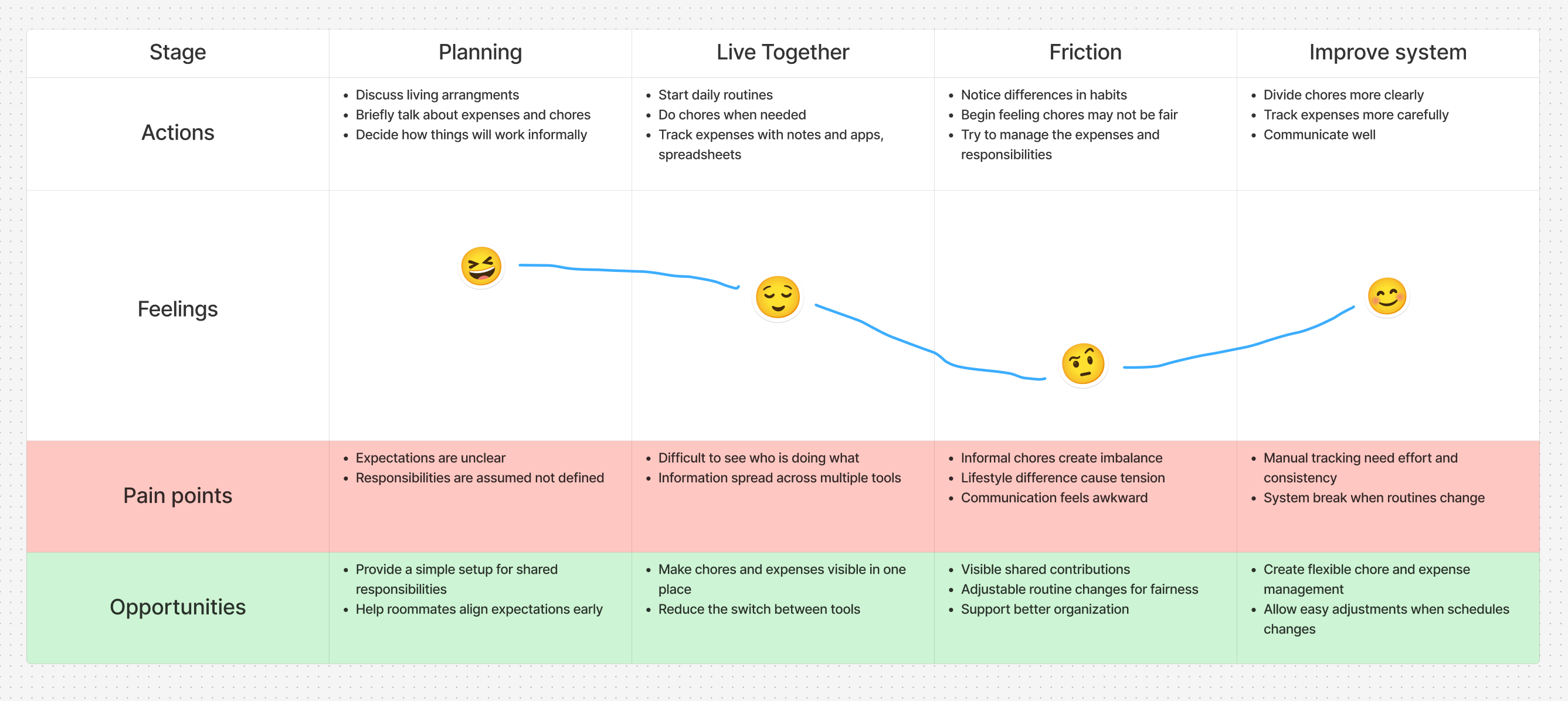
User Journey
Starting The Design

Brainstorm
Goals
・Make daily responsibilities easy to scan and complete
・Provide clear visibility of shared chores and expenses
Thoughts Process
・Grouping into “Today” and “Upcoming” improves prioritization
・Minimal layout reduces cognitive load
Centralized navigation minimizes tool-switching and keeps all household information accessible within one app.
Clear task assigned increases accountability and reduces household friction.

Goals
・Provide roommates with clear visibility of shared expenses
・Simplify adding and managing household costs
Thoughts Process
・Users need a quick overview of shared expenses at a glance
・“Overview” and “Subscription” improve predictability
Separating one-time expenses from recurring subscriptions improves financial transparency.
User Flow
Outlines two primary tasks. The structure minimizes friction and ensures users can quickly return to an updated overview after completing an action.
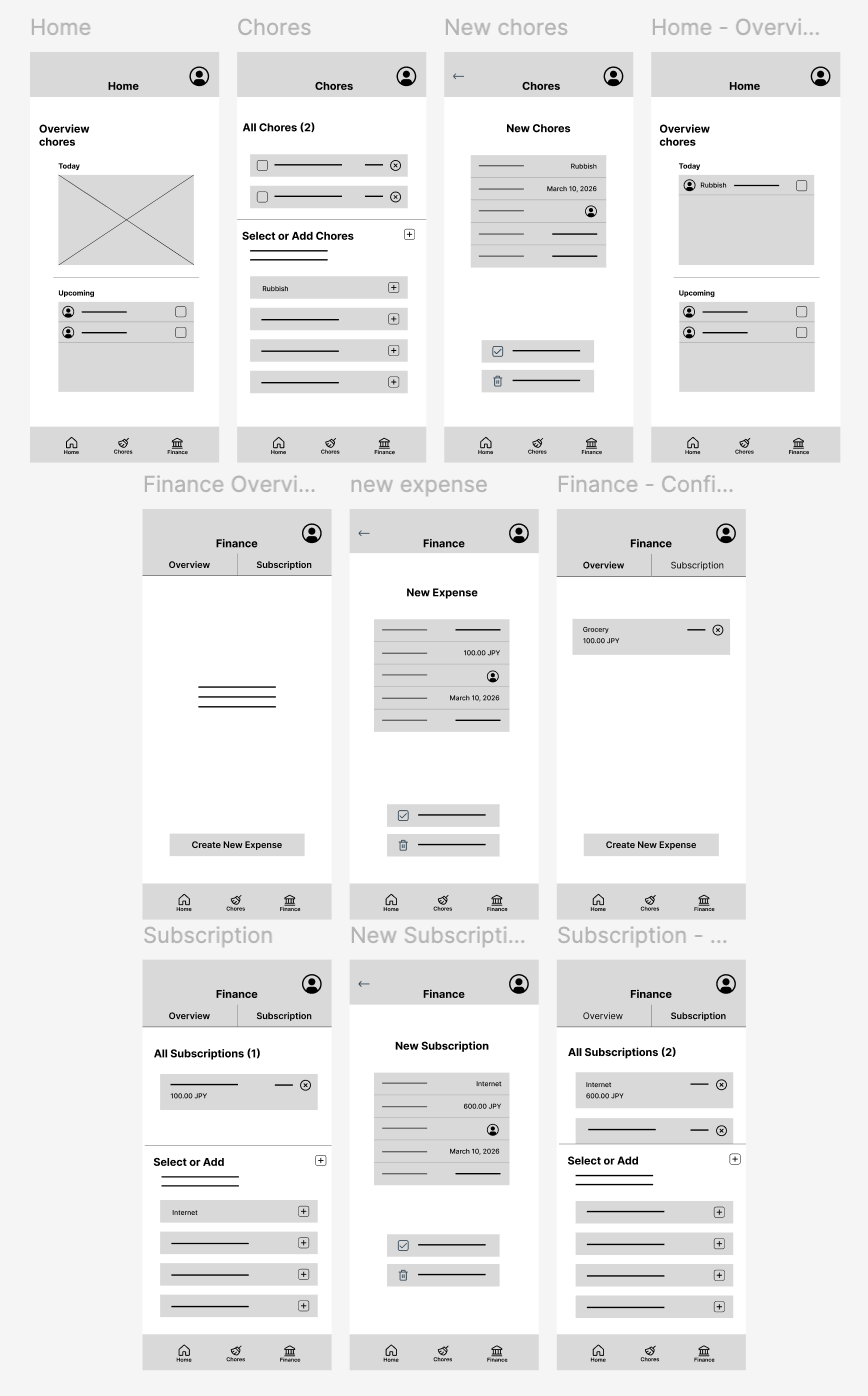
Lo-Fi Wireframe
Refining The Design
Mockups
Usability Study
I conducted a moderated usability study to evaluate how effectively users could manage and organize household chores within the app. The goal was to understand how users interpret the home screen structure, complete core tasks, and navigate key actions such as adding and assigning chores.
Findings
Users prefer time-based organization.
Participants expected tasks grouped by Today and Upcoming, not by member, to quickly see what needs immediate attention.
Back navigation and Delete action create confusion.
Users were unsure whether tapping the back icon would cancel changes, creating hesitation and error risk.
“Add Chores” lacks visibility.
The primary action does not stand out, reducing discoverability and creating friction in the core flow.
Goals
・Make “Add Chores” immediately noticeable
・Reduce task friction
Thoughts Process
・Increased contrast and visual weight of the CTA
・Clarified primary vs. secondary actions
Before
After
Goals
・Eliminate ambiguity between Back and Delete
・Prevent accidental data loss
Thoughts Process
・Elevated Save as the clear primary action
・Reduced visual competition between navigation and CTA
Before
After
Hi-fi Prototype
Project Takeaways
Learnings
The quality of insights depends on how questions are framed.
Subtle changes in wording can shape participant responses. Improving my ability to ask neutral, open-ended questions is essential to conducting more reliable and unbiased usability research.
Behavior reveals unspoken friction.
Hesitation, repeated taps, and scanning patterns exposed confusion users did not verbalize. Observing interaction patterns was critical in identifying hidden usability gaps.
Next Steps
Support roommate communication.
Although the app enhances task clarity, resolving conflicts still requires external communication, so adding lightweight in-app messaging or shared resources could improve collaboration.
Refine interaction details and expand functionality.
Enhance details such as a calendar date picker, clearer assignment visibility, and stronger interaction states.
© 2026 Harunainbloom
Projects
Case Study 1
+81 90 1912 0506
Case Study 2
seancespring@gmail.com
More questions ?